

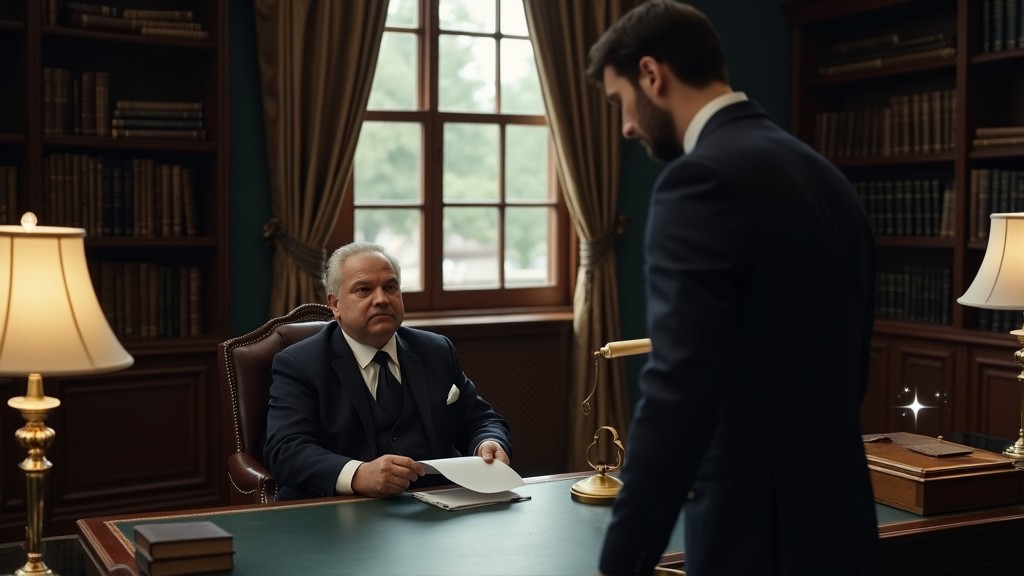
Arthur didn’t move. «Sir, that’s not all.» «What else could there be?» Richard asked irritably.
«According to my data, she doesn’t go to school because she has no documents for enrollment. But every day from opening to closing, she spends in the same place.» «And where?» «In a den for juveniles.»
«In the city public library on Liberty Square, sir.» Richard fell silent. This news didn’t fit the picture he had drawn for himself.
Library. The word sounded alien and absurd in the sterile air of his office. «And what does she do there? Steal books?» He still tried to sarcasm, but confidence began to leave him.
«Reads, sir. We set up surveillance. She arrives exactly at ten in the morning and leaves at eight in the evening.
Takes the same table in the far corner of the foreign literature hall. Lunches with an apple and a piece of bread brought from home. Talks to no one.
Just reads. Books in different languages.» Blood drained from Richard’s face.
«What did you say?» In two days of observation, she read one volume in French, started a book in German, and browsed newspapers in Arabic. Richard collapsed into his huge leather chair. There wasn’t enough air.
A hum rang in his ears. «And neighbors? Teachers? Anyone?» «Neighbors hardly see her. Say she’s a quiet girl, always with a book.
She had no school teachers here. We checked data through immigration. Her parents really worked in diplomatic missions.
She was born in Cairo, lived in Beijing, Berlin, Paris.» Arthur continued speaking, but Richard no longer heard him. City names flashed in his mind like hot coals.
Cairo, Beijing, Berlin, Paris. It wasn’t a lie. Nothing in this report was a lie.
The lie was his world. «Out,» he croaked without looking at the assistant. «Sir?» «Out of here, leave the folder and get out.»
When the door closed behind Arthur, Richard sat motionless for a long time. Then he reached out and took the folder. His fingers trembled.
He opened it. Inside, clipped, was a photo taken with a long-focus lens. Lucia sat at a table in the library.
Light from a high window fell on her bowed head. An open book lay before her. Her face was concentrated and peaceful.
There was no trace of the poverty and hopelessness he expected to see. She was in her world. A world inaccessible to him.
Rage, cold and powerless, rose in him again. He couldn’t accept it. Facts, reports, photos—all could be fake, coincidence, anything.
He had to see everything with his own eyes. Convince himself. Find a flaw in this perfect picture.
He jumped up, grabbed his car keys, and ran out of the office, leaving unfinished coffee and the report that ruined his morning on the table. The Harlem district was another world. As soon as his luxury car turned off the central avenue, the shine of shop windows and skyscraper glass was replaced by peeling plaster, gray walls with graffiti, and a tangle of wires overhead.
The air became thicker, smelling of dust, cheap food, and hopelessness. Richard disgustedly locked the doors and raised the windows, barricading himself from the reality outside. People on the streets looked at his car with hostility and curiosity.
He felt like an outsider, an invader on enemy territory. He parked two blocks from the library, pulled a simple cap over his head, and raised his jacket collar. It seemed to him that everyone was looking at him, that his whole biography was written on his face.
Millions, power, contempt. He walked quickly, almost ran, trying not to look around, not to breathe this air. The city library building was old but majestic, cracked steps, high columns at the entrance.
He pushed the heavy oak door and entered. The smell of old books and dust hit his nose, a smell he hadn’t felt since childhood. Inside it was quiet and dim.
High ceilings, long rows of shelves stretching into semi-darkness. Few visitors sat at tables. Old men reading newspapers, students bent over textbooks.
He felt uncomfortable; here his money had no power. His suit worth thousands of dollars looked ridiculous. He slowly walked along the shelves, pretending to look for a book.
His heart pounded in his throat. What if she’s not here? What if it’s all a mistake? He reached the foreign literature hall. And saw her.
She sat just like in the photo, at a table in the far corner with her back to him. A quiet, motionless figure. A stack of books lay before her.
Richard froze behind one of the shelves, watching. Minutes dragged torturously long; she just read, slowly turning pages. Nothing happened.
He felt a prick of disappointment mixed with relief. Maybe Arthur was wrong. Maybe she’s just looking at pictures.
He was about to leave when a short plump woman with a confused face approached her table. She held some prospectus and spoke quickly in an unfamiliar language, gesturing desperately. Richard listened.
The language was sharp, guttural. Lucia raised her head. She listened attentively to the woman, nodding.
Then she replied. Replied in the same language. Her voice was quiet but confident.
She took the prospectus from the woman, read it, then took a pen and city map from her bag. She began explaining something, pointing on the map. The woman listened, and panic on her face gradually turned to gratitude.
She bowed several times, saying something fervently, and left enlightened. Lucia saw her off with a look and buried herself in her book again, as if nothing happened. Richard stood behind the shelf, unable to move.
He didn’t know what language it was, but he knew one thing—it wasn’t English. And she spoke it fluently. He felt the floor slip from under his feet.
This was only the beginning. He stayed. He had to see everything.
An hour later, a thin young man with a backpack approached her. He timidly asked something in English with a strong accent. Lucia answered him in purest English without the slightest hitch, explaining how to get to the needed shelf.
Then an elderly man dropped his cane. Lucia picked it up and gave it to him, saying a few warm words in flawless German. The man looked at her in surprise and broke into a smile, replying in the same language.
Richard stopped hiding. He just sat at a free table a few meters from her and watched. He couldn’t tear his gaze away.
It was like an incredible performance staged just for him. The janitor girl. Eight voices of truth.
Richard sat, turned to stone. He watched as the janitor girl he had mentally trampled and humiliated spoke German with an elderly professor, each word honed like a blade. She didn’t just speak.
She conducted a conversation. Her gestures were calm, a light respectful smile played on her face. The old man, who at first looked down on her, now listened with genuine interest, nodding and clarifying something.
Richard didn’t understand a word, but he saw the main thing. It was a dialogue of equals. When the German, heartily thanking, walked away, Lucia plunged into her book again, as if switching an invisible toggle inside herself.
Silence. Calm. As if there had been no conversation.
Richard felt a chill run down his spine. This wasn’t coincidence, not a memorized phrase; it was the second language in an hour. He forced himself to look away.
His brain feverishly sought explanations. Maybe she’s from an immigrant family? Maybe her parents are German? But Arthur’s dossier said she’s an orphan. A dark-skinned girl.
Where does German come from? His world, so understandable and ordered, where everyone had their place, began to crack. He felt not just an observer, but a defendant in an invisible court where his own beliefs were the main accused. Another 20 minutes passed.
Richard was already thinking the performance was over when a young couple entered the hall. They looked around confusedly, holding a city map. They spoke quickly and emotionally in a melodious language Richard recognized—Portuguese.
He himself did business in Brazil and understood it a bit. The tourists approached the duty librarian’s table, an elderly woman in glasses, and tried to ask something. The librarian just helplessly shrugged and repeated in English.
«I don’t understand, sorry.» Tension grew. The young man began to get irritated, his voice louder.
And then… Lucia raised her head again. She looked at them, then at the librarian, and quietly stood from her table. She approached the couple.
«Can I help you?» she asked in purest Portuguese. Richard flinched; he clearly heard the phrase, no accent, no hesitation, as if born in Lisbon. The tourists’ faces changed instantly.
They spoke with relief, explaining they were looking for the street with the famous modern art museum. Lucia smiled, took their map, and began explaining the route in detail. She didn’t just show the way.
She advised which bus to take, where to eat cheaply and tasty along the way, and even warned that the museum is closed on Mondays. She talked with them for five minutes. And it was a lively, unforced conversation full of chuckles and friendly advice.
When they left, the girl turned and said to Lucia, «Thank you so much! You saved us. We were desperate.» Lucia just modestly nodded and returned to her table.
Third language. Richard felt his mouth dry. His self-confidence, cynicism, ironclad rightness—all began to melt like ice under scorching sun.
He looked at this fragile girl and for the first time in life didn’t know what to think. She was a riddle his mind, used to shelving everything and valuing in monetary equivalent, couldn’t solve. He decided to stay until the end.
Until closing. He had to see everything. He moved to another table, closer, no longer hiding much; he didn’t care if she noticed.
He was a front-row spectator at a spectacle ruining his universe. Time passed. The library grew quieter.
And then she appeared. A woman in a bright sari, with a red dot on her forehead. She led a little boy about six by the hand.
The woman approached the children’s books shelf and began searching confusedly, flipping through spines. She spoke to her son in a language Richard couldn’t even approximate. Lucia seemed to doze over her book, but she heard…





Обсуждение закрыто.