

He watched her from across the opulent dining room, a predator observing its prey. She was just a waitress, another face in the endless sea of people who served him. But tonight, something was different. Fueled by vintage scotch and the sycophantic laughter of his associates, a cruel idea sparked in his mind. He lifted his hand, beckoning her over. When she stood before his table, he didn’t offer a compliment or another order.

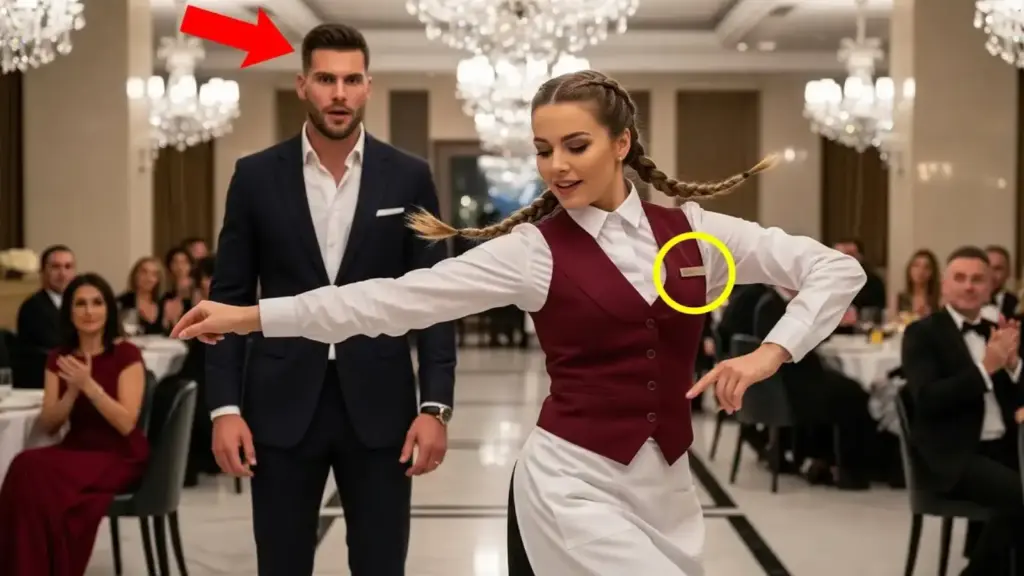
He pointed a platinum credit card at her, the gesture dripping with condescension, and said, loud enough for everyone to hear, «I’ll pay you ten thousand dollars to dance for us, right now. Prove you’re more than just a tray-carrier.»
The room fell silent.
But he, Rhys Covington, had miscalculated. He thought he was buying a moment of humiliation. He had no idea he was about to ignite a fire that would burn his entire world to the ground.
Ethelred’s was not a restaurant. It was a statement, perched on the sixty-fifth floor of a skyscraper overlooking Central Park. Its floor-to-ceiling windows framed a glittering panorama of New York City.
The air inside was thick with the scent of money, a blend of expensive perfume, aged leather, and the subtle, mouth-watering aroma of truffle oil. The clinking of Christofle silverware against Bernardaud porcelain was the room’s delicate heartbeat. For the patrons, it was a sanctuary of power.
For the staff, it was a battlefield of quiet servitude. Catalina Petrova knew this battlefield well. For two years, it had been her entire world.
Each night, she donned the starched, unforgiving black uniform, pulled her cascade of honey-blonde hair into a severe bun, and schooled her face into a mask of polite neutrality. She moved with an economy of motion that bordered on art, her steps silent and swift, her hands steady as she poured a 1982 Chateau Margaux or placed a plate of seared foie gras before men who wouldn’t remember her name, let alone her face. Tonight, the prize-jewel of Ethelred’s clientele was holding court in the corner booth.
Rhys Covington. The name was a headline, a brand, a force of nature. At thirty-four, he was the CEO of Covington Global, a tech and private equity behemoth that devoured smaller companies like a shark.
He was brutally handsome, with sharp, intelligent eyes the color of slate and a jaw that looked like it had been carved from granite. He wore a custom Tom Ford suit as if it were a second skin, a Patek Philippe watch gleaming discreetly on his wrist. Catalina had served his table three times tonight.
He hadn’t looked at her once. He spoke in a low, confident rumble, his attention fixed on his two associates, Oliver Finch and another man she didn’t recognize. They were celebrating a hostile takeover, their laughter sharp and triumphant.
Catalina refilled their water glasses, her presence as significant as a gust of air from the climate control system.
«The board folded like a cheap suit,» Rhys was saying, a smirk playing on his lips. «They talked about company culture and loyalty.»
«Pathetic. Every person has a price, Oliver. You just have to find it.»
Oliver Finch, a man with a kinder face and weary eyes, shifted in his seat.
«Perhaps some things aren’t for sale, Rhys.»
Rhys let out a short, derisive laugh. «Name one.»
It was then that his gaze, sweeping the room with bored ownership, finally landed on Catalina as she cleared a nearby table. He watched her for a moment, his eyes narrowing. He saw the ramrod-straight posture, the controlled grace in the way she bent to lift a heavy tray.
To his cynical mind, it registered not as dignity, but as practiced subservience. A cruel, alcohol-fueled idea took root. He wanted to prove his point to Oliver, to the world.
He lifted a manicured hand, a gesture both lazy and commanding. «Waitress?»
Catalina’s heart gave a little jump. Being singled out by a table like this was never good.
She approached, her hands clasped behind her back. «Yes, sir.»
Rhys didn’t invite her closer. He made her stand at the edge of the booth, a supplicant. He leaned forward, his voice a low drawl that carried in the suddenly quieted atmosphere.
He pulled out his wallet, a sleek piece of black alligator leather, and extracted a platinum card. He didn’t offer it to her. He pointed it at her like a weapon. «I have a proposition for you.»
He began, the smirk returning. His associates stilled, watching the unfolding spectacle. «My associate here believes some people possess a dignity that can’t be bought.»
«I disagree. I say everyone has a price.» He tapped the card on the table.
«I’ll pay you ten thousand dollars, right here, right now. All you have to do is dance for us.»
A collective, muffled gasp rippled through the nearby tables. Catalina felt a hot flush creep up her neck.
This wasn’t a request. It was a public dissection. He wanted to see her squirm, to see her grapple with her need versus her pride, and then inevitably capitulate.
He wanted to prove that she, like the company he’d just acquired, was just another asset to be bought and controlled.
«Sir,» she whispered, her voice barely audible.
«You heard me,» he said, louder now, enjoying the attention.
«Clear a little space. Dance. Any kind of dance.»
«Entertain us. Ten thousand dollars for five minutes of your time. What do you say? Is your dignity worth more than that?»
Her manager, Mr. Henderson, was already moving towards them, his face a mask of panicked apology. This was a catastrophic breach of decorum, but Rhys Covington was not a man you interrupted.
Catalina looked at Rhys’s face. She saw the cold amusement in his eyes, the utter certainty that he had her pinned. He saw a waitress in a cheap uniform.
He saw rent bills, student loans. He saw desperation, and he was right.
She was desperate, but not for the reasons he imagined. She didn’t think of her tiny shared apartment in Queens or her mountain of debt. She thought of her brother, Nico.
She thought of the sterile white walls of the hospital room, the quiet beep of the machines, the specialist’s grave face as he discussed experimental treatments for systemic juvenile idiopathic arthritis—treatments not covered by any insurance. Ten thousand dollars wasn’t rent money. It was a single dose of medication.
It was two months of physical therapy. It was a sliver of hope. Her pride, the shield she had carried for years, felt paper thin.
It was a luxury she couldn’t afford. But surrender wasn’t in her nature. A different kind of fire, one she had suppressed for so long it had nearly turned to ash, began to glow in her chest.
She met his gaze, and for the first time, her own eyes were not neutral. They were clear, direct, and held a depth of emotion that startled him. She gave a single, sharp nod.
«Fine.»
The word hung in the air, electric.
«But not here.»
She added, her voice suddenly clear and steady. She gestured to the small, empty space near the grand piano where the pianist had just finished his set. «There.»
«And I’ll need you to pay up front.»
Rhys’s smirk widened into a triumphant grin. He had won.
He gestured to the waiter’s station, and within a minute, a portable credit card machine was on the table. He swiped his card, punched in the numbers without looking, and a receipt for ten thousand spooled out. He tore it off and held it out to her.
«Your winnings,» he said, his voice dripping with condescension.
Catalina took the slip of paper. Her hand did not shake.
She folded it once and tucked it securely into her apron pocket. Then she turned her back on him and walked toward the piano. She began to unpin her hair.
The severe bun unraveled, and a cascade of honey-blonde waves tumbled down her back, catching the light of the chandeliers. She kicked off her sensible black work shoes, her bare feet making soft contact with the polished marble floor. The room was utterly silent.
Every diner, every waiter, every busboy was frozen, watching. Rhys Covington leaned back in his booth, crossing his arms. He was ready for the show.
He expected a clumsy, awkward shuffle, a cringeworthy attempt at seduction. He was about to get the shock of his life. Catalina stood in the small circle of light by the grand piano.
The city lights of Manhattan blazed behind her, a silent, glittering audience. She closed her eyes for a single, centering breath. In that moment, she was no longer Catalina Petrova, the waitress.
The starched uniform felt like a costume, and the opulent restaurant faded away, replaced by the scent of rosin and worn wooden floors of a studio she hadn’t seen in five years. She could hear the voice of her old ballet master, Mikhail, a stern Russian émigré who saw the fire in her soul. «Do not dance the steps, Catalina.»
He would say, his voice a gravelly rumble. «Dance the story. Let it bleed from you.»
She opened her eyes. The story tonight was one of fury and grief. She began without music.
The first movement was slow, almost hesitant. She raised her arms not in a graceful arc, but as if pushing against an immense weight. Her fingers trembled, then curled into fists.
Her body contracted, a silent scream of frustration that was so palpable a woman at a nearby table put a hand to her own throat. Rhys Covington’s smirk faltered. This wasn’t the awkward flailing he’d anticipated.
This was something else. This was control. Every muscle in her body was taut, deliberate.
Then she moved. It started in her feet. A complex, percussive rhythm tapped out on the marble, a staccato beat of anger.
Her body followed, erupting from its coiled tension. She launched into a series of movements that were a breathtaking, impossible fusion of classical ballet and raw, contemporary expression. There was the perfect line of an arabesque, held for a heart-stopping second, immediately shattered by a guttural, angular contraction of her torso.
She spun a flurry of fouetté turns, executed with a precision that would have been applauded at the Lincoln Center, but they weren’t clean and pretty. They were dizzying, desperate, as if she were trying to outrun a demon. The diners were mesmerized.
Phones were forgotten. Conversations died. The only sound was the whisper of her bare feet on the floor and her own ragged breathing.
Oliver Finch leaned toward Rhys, his voice a stunned whisper. «Rhys? Who is she?»
Rhys didn’t answer. He couldn’t. His eyes were locked on her.
He, a man who curated his life with priceless art, who could distinguish a Monet from a Manet at twenty paces, recognized the language she was speaking. It was the language of true artistry, of a talent so profound it was almost violent. He felt a strange, unsettling feeling in his chest: the feeling of being utterly, catastrophically wrong.
Catalina was lost in the dance. It was a torrent of everything she had suppressed for five years. The grief for her parents, lost in a car crash that had also shattered her brother’s body.
The rage at the universe for stealing her dream, forcing her to trade her pointe shoes for a serving tray. The fierce, desperate love for Nico that fueled every grueling shift, every sacrifice. She danced the pain of watching her own muscles atrophy while her brother fought to regain the use of his.
She danced the humiliation of begging doctors for payment plans. She danced the despair of lonely nights, wondering if this was all her life would ever be. Her movements were sharp, precise, filled with a sorrow that was achingly beautiful.
A grand jeté was not a leap of joy, but a frantic, desperate reach for something just out of grasp. Her arms, which had carried trays of champagne, now carved through the air, telling a story of loss and resilience. For the finale, she slowed.
She sank to the floor, her body folding in on itself until she was a crumpled heap on the marble. Her shoulders shook with silent sobs. It wasn’t acting.
In that moment, the weight of it all came crashing down. Then, slowly, painfully, she rose. One vertebra at a time, she unfurled, her head the last thing to lift.
She stood tall, her back ramrod-straight once more. Her face was tear-streaked, but her eyes blazed with defiance. It was a declaration: You have not broken me.
She held the final pose, chest heaving, her gaze sweeping over the stunned room until it landed directly on Rhys Covington. The silence that followed was deafening. It stretched for ten, fifteen seconds.
It was broken by a single person. Oliver Finch, his face etched with awe, began to clap. Hesitantly at first, then with conviction, he rose to his feet.
One by one, others joined him. The quiet applause grew into a thunderous, sustained standing ovation. The patrons of Ethelred’s—billionaires and socialites—were on their feet, applauding a waitress.
Rhys remained seated, frozen. The applause was like white noise in his ears. He felt as though he’d been punched in the gut.
He had intended to buy a spectacle of humiliation. Instead, he had paid to witness a masterpiece of raw, untamed genius. He had treated a Stradivarius like a cheap fiddle.
The arrogance drained out of him, replaced by a cold, hollow shame. Catalina ignored the applause. Her eyes, still locked on Rhys, were filled with a cold, righteous fury.
She held his gaze for a long moment, letting him see the full extent of his misjudgment. Then she turned, walked calmly to where she had left her shoes, and slipped them on. She wiped the tears from her face with the back of her hand, a gesture of such raw humanity it made Rhys flinch.
Without a word to anyone, without even a glance at her furious yet dumbfounded manager, she walked straight past the maître d’ through the heavy glass doors of Ethelred’s and out into the hallway, leaving a room full of applause and one utterly shattered billionaire in her wake.
The receipt for $10,000 was still tucked in her apron. She hadn’t earned it. She had taken it as compensation for damages.
The next morning, Rhys Covington woke to a world that was subtly, yet irrevocably, altered. Usually, his mornings were a seamless ritual of efficiency: a 5 a.m. workout with his personal trainer, a glance at the pre-market reports from Asia, and a breakfast of black coffee and dry toast, while his personal assistant, a ruthlessly competent woman named Miss Davies, briefed him on the day’s schedule. But today, he couldn’t focus.
The image of the waitress—Catalina, he’d learned her name was, from a panicked Mr. Henderson—was seared into his mind. Her dance played on a loop behind his eyes: the fury, the grace, the profound, gut-wrenching sorrow. It had been more honest and real than anything he had experienced in years.
His world was one of contracts, algorithms, and calculated risks. It was a world of surfaces, of polite lies and brutal truths hidden behind spreadsheets. Last night, she had ripped all of that away and shown him something elemental, and he had tried to buy it for ten thousand dollars.
The thought made his stomach churn with a feeling he wasn’t accustomed to: self-loathing.
«Sir,» Miss Davies said, her voice cutting through his thoughts, «the board meeting for the Sterling acquisition is at nine. You have a preliminary call with the legal team in twenty minutes.»
«Cancel it,» Rhys said, his voice flat.
Miss Davies blinked. Rhys Covington did not cancel.
«Sir?»
«You heard me. Cancel the morning. All of it.» He stood up, pacing his minimalist penthouse apartment, the city sprawling beneath him.
«I have a new priority. I want you to find someone for me.»
«Of course, Mr. Covington. Name?»
«Catalina Petrova. She was a waitress at Ethelred’s. As of last night, I believe she is formerly employed.»
«Understood. Shall I have a non-disclosure agreement drafted? A severance package?» Miss Davies assumed he was doing damage control, paying for silence.
«No,» Rhys said sharply.
«No agreements, no money. I just… I want to know who she is. Everything.»
«Employment history, education, family. Everything. Use whatever resources you need.»
«Private investigators, data analysts, I don’t care. Be discreet.»
«Yes, sir,» she said, her professional mask hiding her surprise.
For the rest of the day, Rhys was a ghost in his own life. He sat in his office, the chrome and glass reflecting a man he barely recognized. He stared at a priceless Jackson Pollock on his wall, a chaotic masterpiece of drips and splatters, and for the first time, it looked like a cheap imitation of the emotion Catalina had painted in the air with her body.
Meanwhile, the story had already begun to leak. Not from the patrons—their circle was too small and too concerned with appearances—but from the staff. By noon, a grainy cell phone video shot by a busboy hiding behind a service station had surfaced online.
It was titled, «Billionaire Dares Waitress to Dance. You Won’t Believe What Happens Next.» The video went viral.
By mid-afternoon, it had a million views. By evening, ten million. News outlets picked it up.
«Hatch Waitress Dance» was trending. The internet, with its insatiable appetite for David-and-Goliath stories, had found its new heroine. They called her the «Angel of Ethelred’s,» the «firebird in an apron.»
Speculation was rampant. Was she a Juilliard dropout, a former Broadway star, a Russian ballerina who had fled her past? For Catalina, the viral fame was a terrifying, suffocating nightmare.
She had gone straight from the restaurant to her brother’s bedside at the hospital, sitting with him until the morning nurses arrived. When she finally got back to her cramped apartment, her roommate, Jenna, was waiting, her eyes wide, holding up her phone.
«Cat, you need to see this,» Jenna said, her voice trembling with excitement and fear.
Catalina watched the blurry video, her stomach twisting into a knot. She saw herself, a stranger on a screen, her face contorted in a mask of pain and fury. The comments were a blur of praise and pity.
They saw her as an inspiration. She just felt exposed, violated. The one thing that had been truly hers—her dance, her story—was now a piece of public consumption, just as Rhys Covington had intended.
«I have to disappear,» Catalina said, her voice shaking. She unplugged her Wi-Fi router and turned off her phone. «He can’t find me.»
«Who? The billionaire?» Jenna asked. «Cat, what he did was monstrous, but look at this.»
«People are offering you scholarships, contracts. A scout from the American Ballet Theater left a comment.»
«It’s charity, Jenna.»
«It’s pity because some rich monster threw money at a poor girl. That’s not how I want to go back. It’s not about the art anymore.»
«It’s about the spectacle.» She paced their small living room, feeling like a cornered animal. The $10,000, which she had already transferred to the hospital’s billing department, felt like dirty money.
It was the price of her privacy. The next two days were a siege. Reporters began showing up at her apartment building.
She had to sneak out the back to visit Nico. At the hospital, she wore a hoodie and sunglasses, her head down, praying no one would recognize her. The newfound attention was a spotlight, but it felt less like a stage light and more like the beam of a prison watchtower.
On the third day, Miss Davies walked into Rhys’s office and placed a slim file on his desk. «Catalina Petrova,» she announced.
Rhys opened it, his heart pounding with an unfamiliar anxiety.
The report was concise, compiled by the best investigators his money could buy. It was a life story, condensed into bullet points. Catalina Petrova, age 24.
Parents: Andrei and Elena Petrova. Former principal dancers with the Kyiv City Ballet. Immigrated to the U.S. in 1999.
Deceased. Motor vehicle accident. Five years ago.
Education: Admitted to the Joffrey Ballet School on a full scholarship at age 16. Considered a prodigy.
Dropped out at age 19. Reason for withdrawal: The same accident that killed her parents left her younger brother, Nico Petrova (age 14 at the time), with severe lifelong injuries.
Became his legal guardian. Sibling: Nico Petrova, age 19. Currently admitted to St. Damien’s Hospital for Children.
Diagnosis: systemic juvenile idiopathic arthritis. Severe and aggressive form. Multiple surgeries.
Requires ongoing, expensive experimental biologic therapy. Employment history: A string of menial jobs for five years.
Waitress, barista, coat check girl. All cash-based where possible to avoid wage garnishment from medical debt. Financials:
In excess of $400,000 in medical debt. No significant assets. Rhys read the report three times.
The cold, hard facts painted a picture far more devastating than any dance. A prodigy who had sacrificed her entire future for her brother. She wasn’t dancing for pride or for his dirty money.
She was dancing for a life. For her brother’s life. The shame he had felt before was nothing compared to the wave of revulsion that washed over him now.
He hadn’t just been arrogant. He had been cruel. He had taken a woman’s unimaginable pain and turned it into a floor show for his own amusement.
He closed the file. His usual decisiveness, his killer instinct, was gone. He didn’t know what to do.
Sending money would be an insult, a confirmation of her worst fears about him. An apology felt laughably inadequate.
But doing nothing was impossible.
«Cancel the rest of my week,» he said to Miss Davies, his voice hoarse, «and get me everything there is to know about St. Damien’s Hospital and this experimental therapy.»
He was no longer just searching for a woman. He was searching for a way to reckon with the man he had become.
Finding Catalina’s apartment was easy for a man with Rhys’s resources. Approaching it was one of the hardest things he had ever done.
He swapped his tailored suit for dark jeans and a simple gray cashmere sweater, trying to appear less like a corporate raider and more like a human being. He drove himself, leaving his chauffeur and his Bentley behind, and parked his unremarkable black Audi down the street from her walk-up in Astoria, Queens. The building was old.
The brick facade was weathered, the fire escapes zigzagging across its face like iron scars. It was a different universe from his glass tower on Park Avenue. He stood on the sidewalk for a full ten minutes, watching people come and go, trying to find the right words.
There were none. He finally buzzed her apartment, 4B. There was no answer.
He tried again. Nothing. Just as he was about to give up, the main door opened and a young woman with bright pink hair and a nose ring came out.
It was Jenna, on her way to work. She recognized him instantly from the news, and her eyes widened in a mixture of fear and hostility. «You.»
She breathed, planting her feet firmly in the doorway. «You have a lot of nerve coming here.»
«I need to speak with her,» Rhys said, his voice quiet. «Please. It’s important.»
«So you can throw more money at her? Humiliate her some more?» Jenna shot back, her voice dripping with protective venom.
«She’s not here, and if she was, she wouldn’t want to see you. You turned her life into a circus. Reporters are camped out down the block.»
«Do you have any idea what you’ve done?»
Rhys had the grace to look ashamed. «I know. I… I made a mistake.»
«A terrible one. I need to apologize.»
«An apology isn’t going to fix this,» Jenna said, but his visible contrition had softened her stance slightly.
She sighed, a puff of frustrated air. «Look, she’s not here. She’s probably at the hospital, St. Damien’s, with her brother.»
«Now, please, just leave her alone.» She pushed past him and hurried down the street.
Rhys stood there for a moment, the name of the hospital echoing in his head. It confirmed the file. He got back in his car, his resolve hardening.
He wouldn’t ambush her at a hospital. That was a sacred space. But he knew where she had to come back to.
He would wait. Hours passed. The sun began to set, painting the sky in hues of orange and purple.
Rhys sat in his car, watching Apartment 4B’s window. He conducted a billion-dollar business from his phone, his texts and emails as sharp and decisive as ever. But his mind was elsewhere.
He was thinking about sacrifice, about a talent so bright being extinguished by circumstance. His own life had been a seamless ascent, paved with inherited wealth and sharp-edged ambition. He’d never had to sacrifice anything.
Finally, just after 9 p.m., he saw her. She was walking down the street, a small, solitary figure wrapped in an oversized coat. Her hair was hidden under a beanie, her face pale and drawn in the glow of the streetlights.
She moved with a weary tension, her eyes scanning the street for reporters. Rhys got out of the car. She saw him immediately and froze like a deer caught in headlights.
Her hand flew to her coat pocket, clutching her keys like a weapon. Every ounce of exhaustion in her body was instantly replaced by rigid hostility.
«What are you doing here?» she asked, her voice cold and flat.
«Miss Petrova. Catalina,» he began, taking a cautious step forward.
She took a step back.
«I came to apologize.»
«You came to my home,» she corrected him, her voice trembling with barely suppressed rage. «You had me investigated.»
«Don’t insult my intelligence on top of everything else.»
Rhys stopped. «Yes, I did.»
«I needed to understand.»
«Understand what?» she shot back, her voice rising.
«That people like me aren’t props for your amusement? That our lives are more than a line item on a balance sheet? Did your investigators tell you that, Mr. Covington?»
«They told me you were a prodigy,» he said softly. «They told me what you gave up for your brother.»
The mention of her brother made her flinch as if he’d struck her.
«You will not speak about my brother. You have no right.»
«I know,» he said, and the sincerity in his voice was undeniable.
«What I did… it was inexcusable. It was arrogant and cruel, and I will regret it for the rest of my life. The world sees the video, the dance.»
«They don’t see the context. I do. And I am profoundly sorry.»
Catalina stared at him, her chest tight. She had expected blustering excuses, another offer of money. She had not expected this quiet, soul-deep shame.
It disarmed her. But the anger was still there, a shield against the man who had laid her soul bare for the world to see.
«Your apology doesn’t make the reporters go away,» she said, her voice brittle. «It doesn’t give me back my privacy.»
«It doesn’t change the fact that people now look at me with pity.»
«I want to help,» Rhys said, stumbling back into his default mode. «The foundation I run… we could create a grant, a full scholarship to any dance conservatory you choose.»
«We can cover all of Nico’s medical expenses. All of them. Just name your price.»
«I’ll make this right.»
It was the worst possible thing he could have said. Catalina’s face, which had softened for a moment, hardened into marble.
A bitter, mirthless laugh escaped her lips. «‘Name my price?'» she repeated, the words dripping with scorn.
«You still don’t get it. You still think this is a transaction. You think you can throw your money at this ugly thing you created and wash it all away—my life, my brother’s health, my talent.»
«It’s not for sale, Mr. Covington. It never was.»
She took a deep breath, her eyes glittering with unshed tears of pure fury.
«The $10,000 you paid me, I gave it to the hospital. It bought Nico two weeks. That is the only transaction you and I will ever have.»
«Thank you for that. And now I want you to leave. And I never, ever, want to see you again.»
She turned on her heel and walked to her building, fumbling with her keys. She didn’t look back. Rhys stood on the sidewalk, the cold night air biting at his skin.
He felt as though she had reached into his chest and squeezed his heart. It’s not for sale. The words echoed in his mind, a final, damning judgment.
He had come here to fix a problem the way he always did: with money, power, and influence. And he had failed. Spectacularly.
He had thought the dance was her story. He was wrong. The dance was just the prologue.
Her real story was one of integrity. And he had just discovered that it was the one currency he didn’t possess and couldn’t buy. As he walked back to his car, he knew that a simple apology and a blank check wouldn’t be enough.
To make this right, he would have to change the very rules of the game he thought he had mastered. Rhys Covington did not become a billionaire by accepting defeat. Catalina’s rejection, as cutting and absolute as it was, didn’t deter him.
It redefined the objective. The problem wasn’t a financial one to be solved, but a moral one to be reconciled. He returned to his world of glass and steel, not with a sense of failure, but with a new, singular purpose.
His first call was not to his lawyers or bankers, but to Dr. Anjali Sharma, the head of pediatric rheumatology at St. Damien’s Hospital. He made the call himself, bypassing Miss Davies. He introduced himself, and after a moment of stunned silence on the other end of the line, he got straight to the point.
«I’ve been made aware of your work with experimental biologic therapies for SJIA,» Rhys stated, his tone devoid of its usual arrogance, replaced by a focused intensity. «Specifically, for a patient named Nico Petrova.»
Dr. Sharma was cautious. «Patient information is confidential, Mr. Covington.»
«I’m not asking for information,» Rhys clarified. «I’m offering to provide funding.»
«I want to underwrite the entire research program. New equipment, more staff, full funding for clinical trials for the next five years.»
«And I want to create a patient access fund to cover the costs for any family that cannot afford treatment, starting with the Petrovas. Anonymously. My name is not to be associated with it in any way.»
«A corporate donation from a Covington Global subsidiary. That’s it.»
The silence on the other end of the line was profound. Dr. Sharma, who spent half her time fighting for grants and begging for donations, was speechless.
The sum Rhys was proposing was enough to change the lives of hundreds of children.
«Mr. Covington, I… I don’t know what to say. This would be transformative.»
«Just say you’ll accept it,» Rhys said, «and that Nico Petrova will receive the best care on the planet, cost being no object, effective immediately.»
«Yes,» Dr. Sharma breathed.
«Of course, yes.»
That was the first piece. The easy piece. The second was more complex.
Catalina had rejected his money because it was a handout, a transactional apology. He needed to create an opportunity, not charity. He needed to build a stage, not a gilded cage.
He spent the next week in a whirlwind of activity. He leveraged his network not for financial gain, but for artistic consultation. He met with the directors of the American Ballet Theater, the board of the Juilliard School, and choreographers whose names were legends.
He wasn’t buying talent. He was learning about the world that had been stolen from Catalina. He learned about the brutal toll that dance takes on the body, the short careers, the constant threat of injury that could end a dream in an instant.
He learned about the thousands of talented young artists who were one medical bill, one family crisis away from giving it all up. An idea began to form, grand and audacious. It wasn’t about one dancer.
It was about all of them. Oliver Finch found him late one night in the office, surrounded by blueprints and proposals, not for a skyscraper, but for a different kind of structure.
«I thought you’d be halfway to Tokyo for the Nakatomi deal,» Oliver said, loosening his tie.
«Postponed it,» Rhys replied, not looking up from a document. «Look at this.»
He slid a proposal across the vast mahogany desk. The title read, «The Phoenix Initiative.» Oliver read it, his eyebrows climbing higher with each page.
It was a proposal for a new foundation endowed with a staggering hundred million dollars of Rhys’s personal fortune. Its mission was twofold: First, to provide full financial and medical support for promising young dancers and performing artists whose careers were threatened by injury or personal crisis.
Second, to build a state-of-the-art performance and rehabilitation center, a place where art and healing could coexist.
«My God, Rhys,» Oliver whispered. «This is incredible.»
«What brought this on?»
«You said some things aren’t for sale,» Rhys said, finally looking up. His eyes were tired but clear, filled with a resolve Oliver hadn’t seen before.
«You were right. But that doesn’t mean they can’t be supported, nurtured. This isn’t charity. It’s an investment in human potential.»
He was building a world where someone like Catalina wouldn’t have to choose between her brother’s life and her own.
While Rhys was building his quiet revolution, Catalina was fighting a war of attrition. A few days after their encounter, she received a call from Dr. Sharma.
«Catalina, I have some wonderful news,» the doctor said, her voice buoyant with a joy Catalina hadn’t heard in years. «A new corporate grant has just come through. It’s specifically for our SJIA research and patient support.»
«The long and short of it is this: Nico’s entire treatment plan, from today until he is in full remission, is completely covered. All of it.»
Catalina sank into a chair. The phone pressed hard against her ear. She was crying, silent tears of overwhelming relief rolling down her cheeks.
For five years, she had been carrying a mountain on her back, and in a single phone call, it had vanished. She didn’t question where it came from. In a city of immense wealth, anonymous corporate philanthropy wasn’t unheard of.
She accepted it as a miracle, a long overdue moment of grace from a universe that had been relentlessly cruel. The weight of financial desperation lifted, but the weight of her squandered talent remained. The viral video had died down, but its ghost lingered.
She’d had offers, of course, from dance companies and choreographers, but they all felt tainted by the spectacle. They saw the story, not the artist. She ignored them all.
But something had shifted in her. With Nico’s future secure, a tiny, fragile seed of her own future began to germinate in the barren soil of her life. She started waking up at 5 a.m., before Jenna was awake, and clearing the small space in their living room.
She would stretch, feeling the familiar pull and ache in muscles long dormant. She moved through the classical positions, her body remembering the language her mind had tried to forget. It was clumsy at first.
Her balance was off, her endurance gone. But the muscle memory was there, buried deep. Each day, she reclaimed a small piece of herself.
One afternoon, a new player entered the game. Rhys was in a meeting reviewing the shortlist for the Phoenix Initiative’s executive director when his phone buzzed. It was a name from the file he’d had compiled on Catalina: Bianca Dubois.
Bianca had been Catalina’s chief rival at the Joffrey School. The report had described her as intensely competitive and noted several instances of professional jealousy. She was now a rising soloist with a prestigious contemporary dance company in New York.
Rhys, in his deep dive, had seen her name on the program for an upcoming gala at the Lincoln Center, a gala he was now a primary sponsor of. He took the call.
«Mr. Covington.»
Bianca’s voice was smooth as silk, laced with ambition. «I heard about your incredible new initiative. I think it’s simply visionary.»
«I was a contemporary of Catalina Petrova at Joffrey, you know.»
«I’m aware,» Rhys said, his voice neutral.
«She was always dramatic,» Bianca continued, a subtle barb in her tone. «Such a shame what happened. But seeing that video, it brought it all back.»
«I’m performing at the Lincoln Center gala next month, the one you’re sponsoring. I was hoping we could meet. Perhaps I could offer some insight for your foundation, from one artist to another.»
Rhys felt a cold prickle of unease. He recognized her type immediately. She was an opportunist cloaked in the guise of an artist.
She saw his money and influence as a ladder. But she was also a direct link to Catalina’s past.
«I’ll be at the gala,» Rhys said, his voice clipped.
«We can speak then.»
He hung up, a sense of foreboding settling over him. He was building an ark for artists like Catalina.
But he knew that for every true talent, there were sharks like Bianca Dubois circling in the water, drawn by the scent of money and opportunity. And she was on a collision course with the very person he was trying to save.
The Lincoln Center Fall Gala was the glittering apex of the New York Arts and Society calendar. Rhys Covington, usually a reluctant attendee at such events, was now its lead sponsor. His involvement wasn’t just a name on a program.
The Phoenix Initiative was being officially announced that night. It was the public unveiling of his penance. He walked through the grand lobby, a man transformed.
He still wore an impeccably tailored tuxedo. But the arrogant swagger was gone, replaced by a quiet, watchful gravity. He was greeted by fawning board members and socialites.
But his eyes scanned the crowd, searching for a face he knew wasn’t there. He had sent a personal invitation to Catalina, delivered by a professional courier. It was simple, respectful, with a handwritten note: «This is not charity.»
«This is a stage. It’s waiting for you if you ever want it. No strings attached.»
She hadn’t replied. He hadn’t expected her to. He found Oliver by the champagne bar.
«Any sign?» Rhys asked.
Oliver shook his head. «I didn’t think she’d come, Rhys.»
«It’s too much, too soon. But what you’ve built… it’s magnificent. You should be proud.»
«It’s just a building and a bank account until it helps someone,» Rhys replied, his gaze distant.
His conversation was interrupted by a voice like honey laced with ice. «Mr. Covington, it’s a pleasure to finally meet you in person.»
He turned to see Bianca Dubois. She was stunning, her dancer’s physique draped in a backless emerald green gown. Her smile was wet and brilliant, but it didn’t reach her cold, calculating eyes.
«Ms. Dubois,» Rhys said, his voice coolly polite. «I’m looking forward to your performance.»
«I do hope it lives up to the ‘raw emotion’ we’ve all seen recently,» she said, the barb aimed squarely at Catalina. «It’s amazing what goes viral these days. Some of us spend decades perfecting our craft.»
«Others just need a moment of public desperation.»
Rhys’s jaw tightened. «Talent is talent, Ms. Dubois. The public has a way of recognizing the real thing.»
Bianca’s smile faltered for a fraction of a second. She quickly recovered. «Of course. It’s just… I knew Cat. I know her story.»
«I worry she’s being taken advantage of. Her emotional state is so fragile. It would be a tragedy if her little moment of fame ended up hurting her more.»
It was a masterful performance of feigned concern designed to plant seeds of doubt. Rhys saw right through it. This woman wasn’t worried about Catalina.
She was terrified of her. Terrified that the raw, untrained genius of her old rival could eclipse her own polished, technical skill.
«I appreciate your concern,» Rhys said, his voice leaving no room for argument. «Now if you’ll excuse me, I have to speak with the director.»
He turned and walked away, leaving Bianca fuming behind her perfect smile. Backstage, the atmosphere was electric with controlled chaos. Dancers stretched, stagehands scurried, and the air hummed with nervous energy.
Bianca stood in the wings waiting for her cue. Her piece was the highlight of the second act. But her mind wasn’t on her choreography.
It was on Rhys Covington’s dismissive tone, on the whispers about the Phoenix Initiative, on the ghost of Catalina Petrova that seemed to haunt this entire evening. She had spent five years clawing her way to the top, relishing the fact that her greatest rival had vanished. Now, that rival was the most talked-about dancer in the world, all because of one clumsy, emotional outburst in a restaurant.
The injustice of it burned in her gut. Just then, her phone buzzed. It was a text from a journalist she kept on a short leash, a gossip columnist at a tabloid.
Anything on the mystery waitress? The buzz is she’s here tonight.
An idea, venomous and brilliant, sparked in Bianca’s mind. She typed a quick reply.
Source says Covington brought her. Making a scene, trying to leverage her 15 minutes of fame. She’s emotionally unstable. He’s taking advantage.
It was a lie, but a plausible one. It painted Rhys as a predator and Catalina as a pathetic, unstable victim. It cheapened her talent, reducing it to a side effect of a breakdown.
It was perfect. She hit send, a cruel smile gracing her lips. The story would be online before her performance was even over.
Meanwhile, across town, Catalina was not at the gala. She was in a small, rented dance studio in Brooklyn, the kind with scuffed floors and mirrors that had seen better days. It was the first time she had set foot in a proper studio in five years.
The hundred dollars for a two-hour rental felt like an indulgence, but one her soul desperately needed. She wore old leggings and a faded t-shirt. Her body ached, but it was a good ache.
The music from her phone’s small speaker filled the room. It wasn’t a grand symphony, but a simple, melancholic piece for cello. And she danced.
She wasn’t dancing for an audience or for a billionaire’s dare. She was dancing for herself. She was rediscovering her own lines, testing her strength, finding her balance.
The movements weren’t filled with the raw rage of that night at Ethelred’s. They were quieter, more questioning. It was a dance of healing, of piecing together the broken parts of herself.
Rhys’s invitation was on the bench next to her water bottle. She had read his handwritten note a hundred times. A stage. It’s waiting for you.
A part of her was tempted, but a bigger part was terrified. She wasn’t ready to step into his world, a world that included people like Bianca Dubois. She remembered Bianca’s casual cruelty, her «accidental» trips in the hallway, the whispers she would start in the dressing room.
As she finished a combination, she checked her phone for the time. A news alert popped up on her screen. The headline made her blood run cold.
Billionaire Sponsor Rhys Covington Attempts to Push «Waitress Dancer» into Spotlight at Lincoln Center Gala. Sources Claim Petrova is «Unstable» and «Being Manipulated.»
The article was short, vicious, and filled with anonymous quotes painting her as a pathetic mess and Rhys as a manipulative puppet master. It mentioned Bianca Dubois as a «concerned contemporary» who «worried for Catalina’s well-being.»
Catalina sank to the floor, the phone slipping from her hand. It was happening all over again. Her story, her life, was being twisted and sold by others.
But this time, it was worse. They were using her to attack Rhys, the one person who, in his own clumsy way, was trying to atone. And Bianca, her old nemesis, was pulling the strings.
The old fire, the one she thought she was learning to control, roared back to life in her chest. They thought she was unstable. A victim.
A pawn. She stood up, her body trembling not with weakness but with a surge of pure adrenaline. Her quiet dance of healing was over.
She grabbed her bag, her coat, and Rhys’s invitation. She wasn’t going to hide anymore. She wasn’t going to let them write her story for her.
Bianca Dubois wanted a ghost. She was about to get one. Catalina Petrova was going to the gala.
Catalina was in a small, rented Brooklyn studio when the world intruded. In a moment of rest, wiping sweat from her brow, she glanced at her phone. A news alert lit up the screen.
The headline, a poisoned dart: Billionaire Sponsor Rhys Covington Attempts to Push «Waitress Dancer» into Spotlight. Sources Claim Petrova is «Unstable» and «Being Manipulated.» The article was riddled with quotes from a «concerned contemporary,» Bianca Dubois.
The words «unstable» and «manipulated» struck Catalina like a physical blow. Bianca’s venom reached across the years, attempting to poison her comeback, twisting her art into a symptom of a breakdown. The quiet, healing dance she had been practicing died in her heart, replaced by a clarifying, cold rage.
They thought she was a pawn. A victim. She grabbed her coat and Rhys’s crumpled invitation.
She wasn’t going to hide from their lies. She was going to burn them down with the truth. She arrived at the Lincoln Center like a force of nature, her street clothes a stark rebellion against the finery of the gala.
The name Catalina Petrova was all she needed to get past security and be rushed backstage, where she found Rhys in the midst of a crisis meeting. He looked up, and the shock on his face was quickly replaced by awe.
«I saw the article,» she said, her voice devoid of fear. «It’s a lie. You offered me a stage. I’m here to use it.»
This was not the desperate woman from his restaurant. This was a warrior. Rhys looked past her to the bewildered stage manager.
«The program has changed,» he commanded, his voice ringing with absolute authority. «She’s on. Now.»
In the wings, Bianca Dubois froze as the announcer’s voice echoed through the theater, introducing a special performance from the Phoenix Initiative. Her name was not called. Catalina’s was.
The curtain rose on a bare stage. Catalina stood center, bathed in a single spotlight. The audience murmured, recognizing the figure from the viral video.
But the dance she performed was not the one they expected. Gone was the raw grief and fury. In its place was breathtaking control, power, and precision.
Every movement was a direct, elegant refutation of Bianca’s slander. An arabesque held with impossible strength declared her stability. A series of flawless, powerful turns mocked the idea she could be manipulated.
She was not dancing her pain. She was demonstrating her mastery. She ended not in a crumpled heap of sorrow, but in a pose of unshakable strength, chin lifted, her gaze sweeping across the theater.
The silence that followed was heavy with shock before the entire building erupted in a tidal wave of applause. It was a standing ovation, not of pity, but of profound respect for a true artist. As she walked off stage, she passed Bianca, who stood ashen-faced, a ghost at a feast.
Catalina didn’t even look at her. Her victory was so complete, her rival was no longer relevant. She found Rhys waiting in the shadows.
The vast, complicated space between them, filled with money, shame, and power, had finally vanished. All that was left was two people who had seen each other’s true character.
«Thank you,» she said simply, «for the stage.»
«Thank you,» he replied, his voice filled with an emotion she now understood was respect. «For showing them all who you are.»
He didn’t offer her a contract or a check. He offered her something more. «The Phoenix Initiative needs an artistic director. Someone who understands what it means to fight. Someone who can build a stage for others.»
He held out his hand. It wasn’t an offer of charity, but of partnership. She looked at his hand, then into his eyes, and saw not a billionaire, but a man who had finally learned the value of things that can’t be bought.
She placed her hand in his. A new dance was just beginning.
The story of Catalina Petrova and Rhys Covington isn’t just about a dance. It’s a powerful reminder that there is a story behind every face we see, a hidden talent waiting in the most unexpected places. It shows us that true strength isn’t about the money in your bank account, but the fire in your soul.
Catalina’s journey teaches us that even when the world tries to write your story for you, you always have the power to step onto the stage and dance your own truth. It’s a testament to second chances, the humbling power of empathy, and the fact that it’s never too late to right a wrong.