
My 17-year-old daughter was banned from my sister’s wedding for being too young. I didn’t argue. I just said we wouldn’t be attending. But when Christmas came, I made one quiet change, and the entire family lost it.
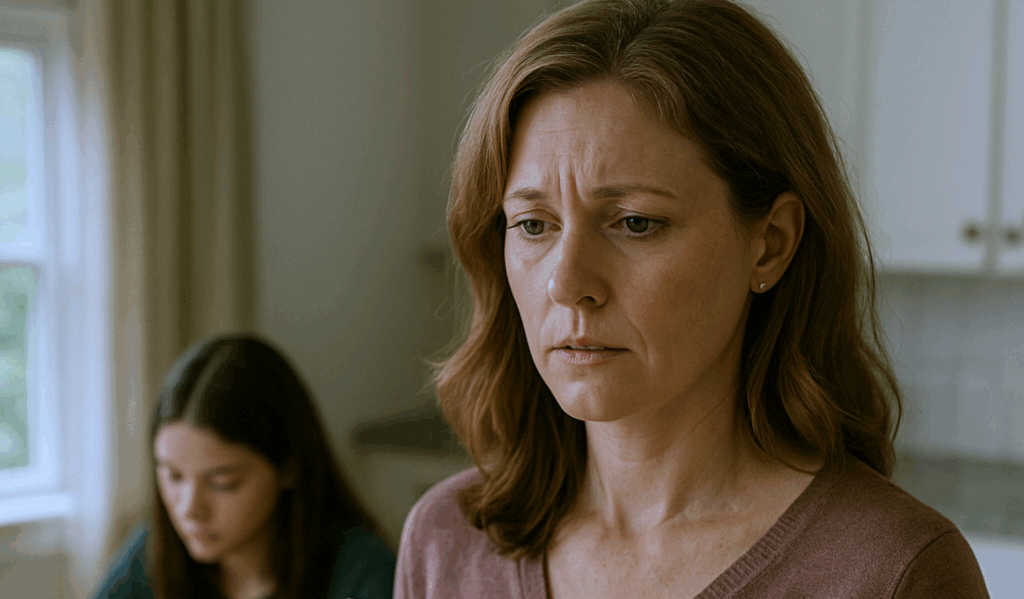
My name is Claire, and I’m the oldest of three sisters. Growing up, that meant I was the responsible one: the helper, the babysitter, the one who handled things when our parents were too tired or too distracted. I never really minded, not at first. That’s just how it was.
Tessa was the middle child, the performer, the attention magnet. Rachel, the youngest, was the baby. She got away with everything. I was the one who cleaned up after everyone else.
When I got older and became a mom myself, things changed a little, but not really. I adopted my daughter, Maya, when she was three years old. She had these big, serious eyes and this quiet way of observing the world, like she didn’t trust it yet. I remember the first time she called me Mom; I cried in the car after I dropped her off at preschool.
From the very beginning, I made a promise to her. She would never feel unwanted in my family. Not ever again. But I couldn’t keep that promise, no matter how hard I tried.
Tessa got engaged last spring. Big announcement. Big ring. Big Instagram caption. I congratulated her, of course. Maya even made her a card, cut out little wedding bells, and glued them on with too much glitter. Tessa said it was sweet, then left it in the backseat of her car. I found it there two weeks later, half-crumpled under a Starbucks cup.
Still, Maya was excited about the wedding. She started looking at dresses online and asking if she should wear her hair up or down. I could tell she was nervous but hopeful. She wanted to be included.
Then the invitation came in the mail. It was one of those fancy ones—thick paper, gold trim—the kind that probably cost more than my monthly water bill. I opened it at the kitchen counter while Maya was doing homework at the table. The usual stuff—location, dress code, RSVP link—and then I saw it: «Adults only, 18+, strictly enforced. No kids.»
I read it twice, thinking maybe I missed something, but I didn’t. Maya saw my face before I could say anything. She looked up from her notebook.
«She doesn’t want me there, does she?» she asked.
«It’s an 18-plus wedding,» I said.
She was quiet for a second, then said, «Is it because I’m adopted?»
That sentence broke something in me. She said it so calmly, like it was just a fact she’d come to accept. I told her no, of course not, but I knew what she meant. It wasn’t the first time something like this had happened. Not exactly this, but other moments, smaller ones, slippery comments.
My mom once introduced Maya as «Claire’s girl,» never our granddaughter. Tessa called her «your daughter,» like she was talking about a neighbor kid. There were times at family holidays when Maya would offer to help in the kitchen, and no one would even respond. I tried to believe it was unintentional, that they didn’t mean anything by it. But this time was clear.
I didn’t fight. I didn’t yell. I just went online and clicked «Not Attending.» No explanation. Just no. I thought that would be the end of it.
The next day, Tessa texted me. «Hey, just saw your RSVP. Is everything okay?» Then a follow-up: «If this is about the age thing, I hope you understand. We’re being super consistent with everyone. Nothing personal, right?» Not personal, except that Maya is her niece and she’s seventeen, not seven. I didn’t answer.
Then Rachel messaged me. «Tessa said you’re not coming. What’s going on?»
Then my mom called. She never calls me just to talk, so I picked up, already bracing myself.
«Claire,» she said, «I heard you’re not going to the wedding. Is this really about the age limit?»
«Maya’s not invited,» I said. «I’m not going without her.»
«She’s almost eighteen,» my mom said. «It’s not like she’s a little kid. She’s family.» There was a pause. «Don’t punish your sister over this. It’s one night.»
I didn’t argue. I just said, «We’re not going,» and hung up.
That should have been it. But then came the group chat messages. The guilt. The little comments that weren’t even subtle. Rachel wrote, «Can’t believe you’re making such a big deal over one rule. You always have to cause drama. Maya is not the only one not coming. This isn’t about her. You’re making it about her.»
My mom sent a long message about family unity and forgiveness, about how we’ve all made sacrifices, about how it’s hard being in the middle. I didn’t respond. Maya deleted the dress photos from her phone. She stopped talking about the wedding. She didn’t cry, but I think that’s what hurt me the most. How unsurprised she was. She’d already learned what I spent too long trying to ignore.
So, when Christmas came around and no one had apologized or even brought it up, I made a quiet decision. I didn’t invite them. No big announcement. No blow-up. Just silence. And that’s what made them really angry.
If you’d asked me ten years ago what I thought motherhood would look like, I would have said birthday parties, messy hugs, and glitter on the carpet. I wouldn’t have said trying to protect a child from people who claim to love you both. When Maya came into my life, she was three years old and heartbreakingly serious. Big brown eyes, soft curls, and a quiet stare that made you feel like she was memorizing everything you said just in case she needed to survive you.
She didn’t warm up quickly. She didn’t giggle on cue. She didn’t run into my arms like a movie scene. But when she finally reached for my hand in the grocery store without being asked, I cried in the parking lot for ten minutes. My husband, Ethan, was the one who said, «That was the moment she chose you.» And I’ve been choosing her every day since.
But my family never quite knew what to do with her. At first, I chalked it up to awkwardness, adjusting. She didn’t have my eyes. She didn’t carry my last name yet. She didn’t jump into conversations at holidays the way the other kids did. But it was more than that.
It was the way my mom referred to her as «the little one» instead of Maya. The way Tessa once asked, «Are you going to tell her she’s adopted when she’s older?» when Maya was standing right there. The way Rachel’s kids got Easter baskets from our parents with personalized names, while Maya got a generic one with a «Happy Spring» tag. It wasn’t overt. It was quieter than that, softer, easier to excuse if you wanted to. But Maya noticed. She always noticed.
I tried to be patient. I really did. I explained. I redirected. I gave them the benefit of the doubt. When Maya was six, she told my dad she wanted to be an artist. He smiled and said, «You’ll need something more practical than that.» When she was eight, she drew a picture of our family—me, Ethan, and her—and gave it to my mom. My mom smiled, said, «Thank you,» then set it down and never mentioned it again. Maya asked later why it wasn’t on the fridge like the other cousins’ drawings. I didn’t know what to say.
The first time I really lost my patience was at Rachel’s engagement party. Maya was twelve. Rachel had invited us, sort of. We were added to a mass text with a time, date, and venue. No «Can’t wait to see you.» No personal message. But we went anyway because I thought, This is how we change it. We keep showing up.
Maya wore a pale blue dress and these little silver flats she’d picked out herself. She was nervous, kept asking if she looked okay, if she could stay close to me. At the party, Rachel greeted us with a tight smile and a «Hi,» then turned to hug the next person without asking Maya anything. No compliment. No «You look so grown up.» Just air. We stayed for twenty minutes, maybe twenty-five. Maya stuck to my side the entire time.








Обсуждение закрыто.