

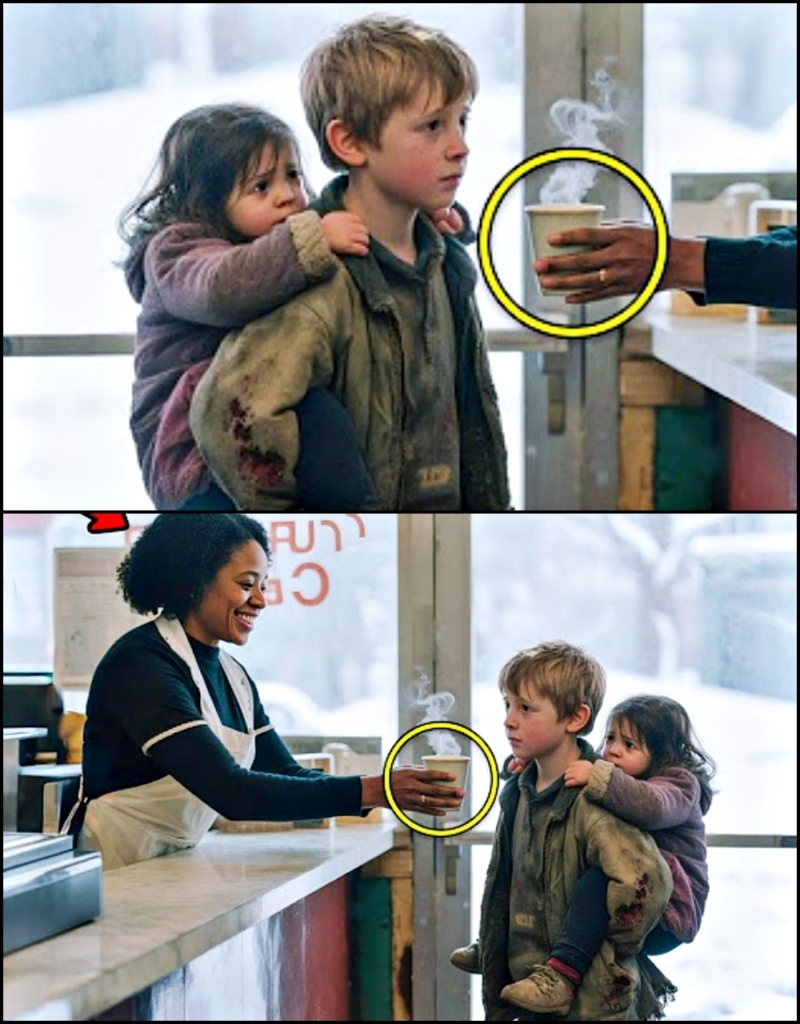
In a snow-covered, impoverished town, a twenty-five-year-old black woman, forced to drop out of college to care for her ailing mother, works as a waitress in a worn-down diner. One night she discovers two orphaned children shivering in the cold and begins secretly feeding them from the kitchen. Despite threats, she never stops.
Years later those same children return, now grown, to save her from a cruel scheme and bring her quiet kindness back into the light.
The snow had been falling all day. Not gentle flakes, but thick, suffocating sheets that buried the sidewalks and silenced the streets of Hallaton, a town so small it didn’t even make the local weather reports. The only sound that dared pierce the wind’s cry was the rusted bell above the diner door, clanging as it closed behind her.
Amara Daniels, twenty-five, exhaled a cloud of warm breath into the freezing night. She tugged her threadbare coat tighter across her chest, scarf wrapped twice around her neck. Her skin, smooth and dark like midnight syrup, was flushed from hours of scrubbing dishes and balancing trays.
Her fingers ached, but her steps were steady. She walked the same route every night from the diner, past shuttered stores and flickering street lamps, boots crunching snow that had turned to slush. The cold bit at her bones, but she didn’t rush.
She never rushed, not since she left college. Back then she was Amara Daniels, sophomore in early childhood education, with lesson plans taped to her dorm wall and a scholarship pinned to her mother’s fridge, but when her mother’s heart began to fail, slowly at first, then all at once, Amara made her choice. Books became bills, classrooms became kitchens.
Now she served eggs to men who didn’t look her in the eyes and cleaned tables for tips that barely covered insulin and rent. The diner was a grim rectangle of neon and peeling paint, Marge’s grill and griddle, where Barlow ran the kitchen like a forgotten war. He was tall, wide in the shoulders, with a jaw like stone and eyes that hadn’t smiled since before the foreclosure.
Once they said he owned three restaurants. Now he wore grease-stained aprons and told Amara not to look so damn hopeful, it makes customers uneasy. He never said her name.
He called her You, or worse, Girl. Amara turned the corner near the old schoolhouse when she heard it. A sound, soft, muffled, a whimper.
At first she thought it was the wind again, weaving sorrow through the trees, but then it came again, closer now, trembling and real. Her eyes darted toward the curve in the road ahead. Headlights blinked through the snow, splintered glass catching moonlight.
A police barrier glowed orange under flashing sirens, casting strange shadows on the asphalt. A mangled sedan lay at the foot of a telephone pole, steam hissing from its hood like a dying thing. Officers stood around it, talking low.
A body was covered in a white tarp near the ditch. Two stretchers loaded into ambulances. No screaming, no crying, just silence.
Then she saw them. Two children sat hunched in the snow behind the barrier, no jackets, no hats, just skin and fear and a thin layer of frost gathering in their hair. The boy looked twelve, maybe younger, holding the girl, no more than eight, tight to his chest.
Her face was red from crying, eyes vacant, hands bare. No one noticed them. Or maybe no one cared to.
One officer glanced in their direction, then turned back to his notepad. A woman in a parka muttered, poor things, and kept walking. A man lit a cigarette.
Amara froze. Her pulse beat loud in her ears. She didn’t move for three seconds.
Then she stepped forward. Through the snow, past the line. Hey, she whispered, kneeling before them.
You’re freezing, the boy flinched, pulling the girl tighter. Don’t touch her. I won’t, I promise.
Amara’s voice softened. My name is Amara. I work just down the street.
The girl peeked at her through tangled curls. Where’s your mom? Amara asked gently. The boy didn’t answer.
She looked at the scene again. The tarp, the sedan, her breath caught in her throat. I’m so sorry, she whispered more to herself than to them.
Then she did what no one else had done. She opened her arms. I’m not gonna leave you, she said.
Not tonight. The girl leaned in first, slowly, cautiously, like a wounded kitten testing a stranger’s palm. Then the boy.
He didn’t cry. Just folded into her chest with a kind of silent fury, like he knew this world didn’t owe him anything. Amara held them both as snow fell harder, soaking through her coat, numbing her knees.
She rocked them, whispered nothing words like, you’re okay now, and I got you. Her hands trembled, but she didn’t pull away. Behind her, the journalist from the Haletine Post paused, raised his camera, the shutter clicked.
The flash glowed white against the falling night. Later, the rescue workers took the children in. They asked for names.
Amara didn’t know them. She only knew that the girl had stopped shivering, and the boy, Eli, she would learn later, had looked at her one last time before being led away. Like he was trying to remember her face.
She stood alone at the edge of the scene, soaked through, too cold to move. But her heart burned like a lantern. The town would forget that night, but the snow never did, and neither did Amara.
It began three nights after the accident. Amara was wiping down the counter, long after the last customer had left and the buzz of the coffee machine had gone quiet. The diner smelled like old grease and burnt toast.
Familiar, if not exactly comforting. Outside, the wind rattled the windows, the storm having passed, but leaving behind piles of snow crusted with ice. Most of the town was asleep.
But Amara wasn’t watching the clock. She was watching the back door. A soft knock came, once, then twice.
She didn’t jump. She’d been waiting. Slipping off her apron, she moved toward the kitchen, passing the humming refrigerator and grabbing a napkin-wrapped bundle from a brown paper bag she’d packed hours ago.
It wasn’t much, half a grilled cheese, two boiled eggs, a handful of mashed potatoes, and the last corner of a blueberry muffin someone hadn’t touched. Not garbage, just unwanted. She cracked the door open.
They were there. Eli stood in front, his shoulders squared like he was bracing for rejection. His coat didn’t fit, probably scavenged from a charity bin.
It hung heavy on his too-thin frame, sleeves covering his fingers. Nina clung to his side, eyes wide but hopeful. Amara smiled.
Hope you’re hungry. The bundle exchanged hands without a word, and then the smallest thing. Nina’s face lit up…







Обсуждение закрыто.