
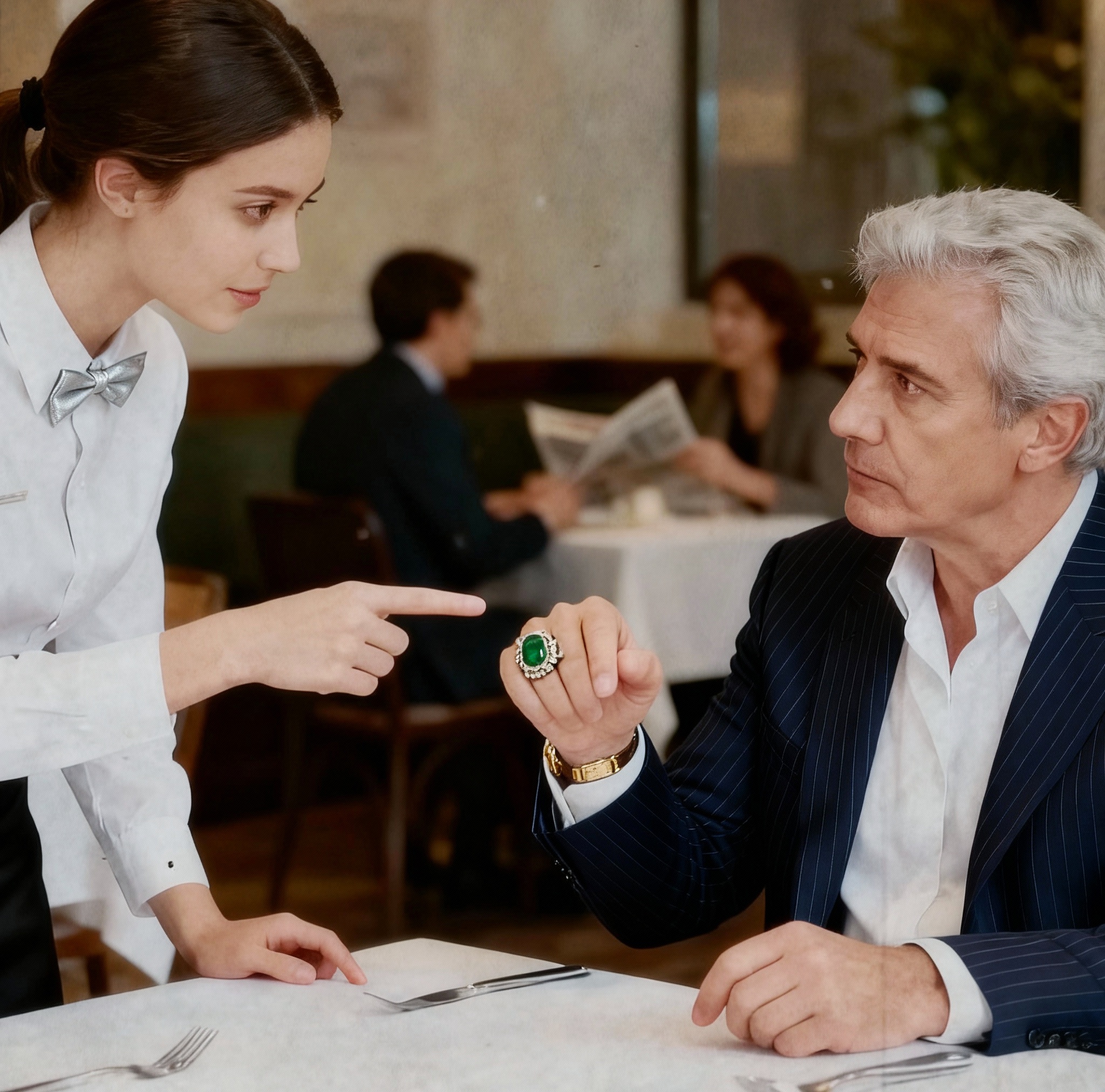
He gestured to the waiter’s station, and within a minute, a portable credit card machine was on the table. He swiped his card, punched in the numbers without looking, and a receipt for ten thousand spooled out. He tore it off and held it out to her.
«Your winnings,» he said, his voice dripping with condescension.
Catalina took the slip of paper. Her hand did not shake.
She folded it once and tucked it securely into her apron pocket. Then she turned her back on him and walked toward the piano. She began to unpin her hair.
The severe bun unraveled, and a cascade of honey-blonde waves tumbled down her back, catching the light of the chandeliers. She kicked off her sensible black work shoes, her bare feet making soft contact with the polished marble floor. The room was utterly silent.
Every diner, every waiter, every busboy was frozen, watching. Rhys Covington leaned back in his booth, crossing his arms. He was ready for the show.
He expected a clumsy, awkward shuffle, a cringeworthy attempt at seduction. He was about to get the shock of his life. Catalina stood in the small circle of light by the grand piano.
The city lights of Manhattan blazed behind her, a silent, glittering audience. She closed her eyes for a single, centering breath. In that moment, she was no longer Catalina Petrova, the waitress.
The starched uniform felt like a costume, and the opulent restaurant faded away, replaced by the scent of rosin and worn wooden floors of a studio she hadn’t seen in five years. She could hear the voice of her old ballet master, Mikhail, a stern Russian émigré who saw the fire in her soul. «Do not dance the steps, Catalina.»
He would say, his voice a gravelly rumble. «Dance the story. Let it bleed from you.»
She opened her eyes. The story tonight was one of fury and grief. She began without music.
The first movement was slow, almost hesitant. She raised her arms not in a graceful arc, but as if pushing against an immense weight. Her fingers trembled, then curled into fists.
Her body contracted, a silent scream of frustration that was so palpable a woman at a nearby table put a hand to her own throat. Rhys Covington’s smirk faltered. This wasn’t the awkward flailing he’d anticipated.
This was something else. This was control. Every muscle in her body was taut, deliberate.
Then she moved. It started in her feet. A complex, percussive rhythm tapped out on the marble, a staccato beat of anger.
Her body followed, erupting from its coiled tension. She launched into a series of movements that were a breathtaking, impossible fusion of classical ballet and raw, contemporary expression. There was the perfect line of an arabesque, held for a heart-stopping second, immediately shattered by a guttural, angular contraction of her torso.
She spun a flurry of fouetté turns, executed with a precision that would have been applauded at the Lincoln Center, but they weren’t clean and pretty. They were dizzying, desperate, as if she were trying to outrun a demon. The diners were mesmerized.
Phones were forgotten. Conversations died. The only sound was the whisper of her bare feet on the floor and her own ragged breathing.
Oliver Finch leaned toward Rhys, his voice a stunned whisper. «Rhys? Who is she?»
Rhys didn’t answer. He couldn’t. His eyes were locked on her.
He, a man who curated his life with priceless art, who could distinguish a Monet from a Manet at twenty paces, recognized the language she was speaking. It was the language of true artistry, of a talent so profound it was almost violent. He felt a strange, unsettling feeling in his chest: the feeling of being utterly, catastrophically wrong.
Catalina was lost in the dance. It was a torrent of everything she had suppressed for five years. The grief for her parents, lost in a car crash that had also shattered her brother’s body.
The rage at the universe for stealing her dream, forcing her to trade her pointe shoes for a serving tray. The fierce, desperate love for Nico that fueled every grueling shift, every sacrifice. She danced the pain of watching her own muscles atrophy while her brother fought to regain the use of his.
She danced the humiliation of begging doctors for payment plans. She danced the despair of lonely nights, wondering if this was all her life would ever be. Her movements were sharp, precise, filled with a sorrow that was achingly beautiful.
A grand jeté was not a leap of joy, but a frantic, desperate reach for something just out of grasp. Her arms, which had carried trays of champagne, now carved through the air, telling a story of loss and resilience. For the finale, she slowed.
She sank to the floor, her body folding in on itself until she was a crumpled heap on the marble. Her shoulders shook with silent sobs. It wasn’t acting.
In that moment, the weight of it all came crashing down. Then, slowly, painfully, she rose. One vertebra at a time, she unfurled, her head the last thing to lift.
She stood tall, her back ramrod-straight once more. Her face was tear-streaked, but her eyes blazed with defiance. It was a declaration: You have not broken me.
She held the final pose, chest heaving, her gaze sweeping over the stunned room until it landed directly on Rhys Covington. The silence that followed was deafening. It stretched for ten, fifteen seconds.
It was broken by a single person. Oliver Finch, his face etched with awe, began to clap. Hesitantly at first, then with conviction, he rose to his feet.
One by one, others joined him. The quiet applause grew into a thunderous, sustained standing ovation. The patrons of Ethelred’s—billionaires and socialites—were on their feet, applauding a waitress.
Rhys remained seated, frozen. The applause was like white noise in his ears. He felt as though he’d been punched in the gut.
He had intended to buy a spectacle of humiliation. Instead, he had paid to witness a masterpiece of raw, untamed genius. He had treated a Stradivarius like a cheap fiddle.
The arrogance drained out of him, replaced by a cold, hollow shame. Catalina ignored the applause. Her eyes, still locked on Rhys, were filled with a cold, righteous fury.
She held his gaze for a long moment, letting him see the full extent of his misjudgment. Then she turned, walked calmly to where she had left her shoes, and slipped them on. She wiped the tears from her face with the back of her hand, a gesture of such raw humanity it made Rhys flinch.
Without a word to anyone, without even a glance at her furious yet dumbfounded manager, she walked straight past the maître d’ through the heavy glass doors of Ethelred’s and out into the hallway, leaving a room full of applause and one utterly shattered billionaire in her wake.
The receipt for $10,000 was still tucked in her apron. She hadn’t earned it. She had taken it as compensation for damages.
The next morning, Rhys Covington woke to a world that was subtly, yet irrevocably, altered. Usually, his mornings were a seamless ritual of efficiency: a 5 a.m. workout with his personal trainer, a glance at the pre-market reports from Asia, and a breakfast of black coffee and dry toast, while his personal assistant, a ruthlessly competent woman named Miss Davies, briefed him on the day’s schedule. But today, he couldn’t focus.
The image of the waitress—Catalina, he’d learned her name was, from a panicked Mr. Henderson—was seared into his mind. Her dance played on a loop behind his eyes: the fury, the grace, the profound, gut-wrenching sorrow. It had been more honest and real than anything he had experienced in years.
His world was one of contracts, algorithms, and calculated risks. It was a world of surfaces, of polite lies and brutal truths hidden behind spreadsheets. Last night, she had ripped all of that away and shown him something elemental, and he had tried to buy it for ten thousand dollars.
The thought made his stomach churn with a feeling he wasn’t accustomed to: self-loathing.
«Sir,» Miss Davies said, her voice cutting through his thoughts, «the board meeting for the Sterling acquisition is at nine. You have a preliminary call with the legal team in twenty minutes.»
«Cancel it,» Rhys said, his voice flat.
Miss Davies blinked. Rhys Covington did not cancel.
«Sir?»
«You heard me. Cancel the morning. All of it.» He stood up, pacing his minimalist penthouse apartment, the city sprawling beneath him.
«I have a new priority. I want you to find someone for me.»
«Of course, Mr. Covington. Name?»
«Catalina Petrova. She was a waitress at Ethelred’s. As of last night, I believe she is formerly employed.»
«Understood. Shall I have a non-disclosure agreement drafted? A severance package?» Miss Davies assumed he was doing damage control, paying for silence.
«No,» Rhys said sharply.
«No agreements, no money. I just… I want to know who she is. Everything.»
«Employment history, education, family. Everything. Use whatever resources you need.»
«Private investigators, data analysts, I don’t care. Be discreet.»
«Yes, sir,» she said, her professional mask hiding her surprise.
For the rest of the day, Rhys was a ghost in his own life. He sat in his office, the chrome and glass reflecting a man he barely recognized. He stared at a priceless Jackson Pollock on his wall, a chaotic masterpiece of drips and splatters, and for the first time, it looked like a cheap imitation of the emotion Catalina had painted in the air with her body.
Meanwhile, the story had already begun to leak. Not from the patrons—their circle was too small and too concerned with appearances—but from the staff. By noon, a grainy cell phone video shot by a busboy hiding behind a service station had surfaced online.
It was titled, «Billionaire Dares Waitress to Dance. You Won’t Believe What Happens Next.» The video went viral.
By mid-afternoon, it had a million views. By evening, ten million. News outlets picked it up.
«Hatch Waitress Dance» was trending. The internet, with its insatiable appetite for David-and-Goliath stories, had found its new heroine. They called her the «Angel of Ethelred’s,» the «firebird in an apron.»
Speculation was rampant. Was she a Juilliard dropout, a former Broadway star, a Russian ballerina who had fled her past? For Catalina, the viral fame was a terrifying, suffocating nightmare.
She had gone straight from the restaurant to her brother’s bedside at the hospital, sitting with him until the morning nurses arrived. When she finally got back to her cramped apartment, her roommate, Jenna, was waiting, her eyes wide, holding up her phone.
«Cat, you need to see this,» Jenna said, her voice trembling with excitement and fear.
Catalina watched the blurry video, her stomach twisting into a knot. She saw herself, a stranger on a screen, her face contorted in a mask of pain and fury. The comments were a blur of praise and pity.
They saw her as an inspiration. She just felt exposed, violated. The one thing that had been truly hers—her dance, her story—was now a piece of public consumption, just as Rhys Covington had intended.
«I have to disappear,» Catalina said, her voice shaking. She unplugged her Wi-Fi router and turned off her phone. «He can’t find me.»
«Who? The billionaire?» Jenna asked. «Cat, what he did was monstrous, but look at this.»
«People are offering you scholarships, contracts. A scout from the American Ballet Theater left a comment.»
«It’s charity, Jenna.»
«It’s pity because some rich monster threw money at a poor girl. That’s not how I want to go back. It’s not about the art anymore.»
«It’s about the spectacle.» She paced their small living room, feeling like a cornered animal. The $10,000, which she had already transferred to the hospital’s billing department, felt like dirty money.
It was the price of her privacy. The next two days were a siege. Reporters began showing up at her apartment building.
She had to sneak out the back to visit Nico. At the hospital, she wore a hoodie and sunglasses, her head down, praying no one would recognize her. The newfound attention was a spotlight, but it felt less like a stage light and more like the beam of a prison watchtower.
On the third day, Miss Davies walked into Rhys’s office and placed a slim file on his desk. «Catalina Petrova,» she announced.
Rhys opened it, his heart pounding with an unfamiliar anxiety.
The report was concise, compiled by the best investigators his money could buy. It was a life story, condensed into bullet points. Catalina Petrova, age 24.
Parents: Andrei and Elena Petrova. Former principal dancers with the Kyiv City Ballet. Immigrated to the U.S. in 1999.
Deceased. Motor vehicle accident. Five years ago.
Education: Admitted to the Joffrey Ballet School on a full scholarship at age 16. Considered a prodigy.
Dropped out at age 19. Reason for withdrawal: The same accident that killed her parents left her younger brother, Nico Petrova (age 14 at the time), with severe lifelong injuries.
Became his legal guardian. Sibling: Nico Petrova, age 19. Currently admitted to St. Damien’s Hospital for Children.
Diagnosis: systemic juvenile idiopathic arthritis. Severe and aggressive form. Multiple surgeries.
Requires ongoing, expensive experimental biologic therapy. Employment history: A string of menial jobs for five years.
Waitress, barista, coat check girl. All cash-based where possible to avoid wage garnishment from medical debt. Financials:
In excess of $400,000 in medical debt. No significant assets. Rhys read the report three times.





Обсуждение закрыто.